Well, it has been quite the week, hasn’t it? Look, you can argue that the whole debate over which presidents called Gold Star families and which ones didn’t and what did Trump say to the pregnant war widow has been an overblown distraction. And I get the argument, but ultimately I think this controversy is pretty significant. First, because it speaks to the president’s tendency to respond to criticism with a torrent of untruths and abuse (and also revealed the his chief of staff’s propensity for the same, which was extremely disappointing). This combined, with the press secretary’s announcement that it was “highly inappropriate” to argue with a four-star general, illuminates the current administration’s authoritarian leanings and should alarm everyone with an interest in the United States remaining a democratic republic.
So there’s that. But also, John Kelly has a point–a point that would have been more effective if he hadn’t tacked on a bunch of sanctimonious drivel about how women used to be sacred and a gratuitous and inaccurate attack on Congresswoman Frederica Wilson, but a point nonetheless: the average American doesn’t know a ton about the military and doesn’t have a good feel for what happens when a soldier returns home, especially if the soldier is coming home for the last time. And so I offer these five reading suggestions.
- Thank You For Your Service, by David Finkel. I read this book when it was first published
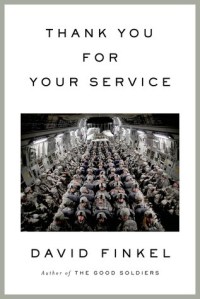 in 2013 and I was blown away. Thank You for Your Service is about what happens to a group of soldiers who spent fifteen months in Baghdad when they return to the United States. Finkel has amazing access and the subjects of his book trust him and he writes about them with great sensitivity. This book is a sequel, of sorts, to The Good Soldiers, which Finkel wrote about the same battalion when they were on duty in Iraq. (I haven’t read The Good Soldiers.) If you only read one book on this list, this should be the one.
 - Soldier’s Heart: Reading Literature Through Peace and War at West Point, by Elizabeth D. Samet.
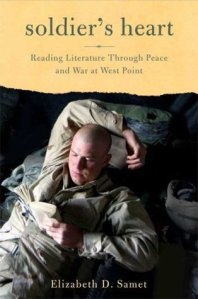 This is a memoir by a former professor of English at West Point. It’s an interesting account of a Harvard-educated politically liberal woman dealing with military hierarchy and learning about the ways her more conservative, bound-for-war students think about themselves and the classics of literature. I like it because I think it challenges stereotypes on both sides; I can’t think of anyone, no matter where they stand on the political spectrum, who could read this and not see the military a little differently.
 - Redeployment, by Phil Klay.
 A book of short stories about soldiers on the frontlines in Iraq and Afghanistan, by a former soldier who served in Iraq. I still wish Klay had written a memoir instead of a book of short stories, but this book still provides a window into the lives of those who are actually fighting the wars.
 - You Know When the Men Are Gone, by Siobhan Fallon.
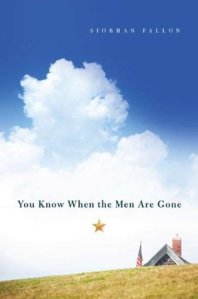 This book is the reverse of the previous one: a collection of short stories about the families who are left behind when soldiers go to war. Fallon, no surprise, is a military wife, and she writes about the stresses and terrors of having your husband on the frontlines in another country very movingly.
 - This Republic of Suffering: Death and the American Civil War, by Drew Gilpin Faust.
 For most Americans today losing a child or a spouse in Iraq or Afghanistan is an abstract concept; we murmur our sympathy but it’s not really a part of the everyday world we inhabit. It was very different for Americans who lived during the Civil War, and in this book Faust writes about how civilians and former soldiers reconciled themselves to the horrible human cost of the war, and how they grappled with the deaths once the war was over. It’s instructive to think about a world in which war deaths are much, much more common than they are today, and perhaps makes it a little easier to imagine what it would feel like if it were your child or spouse who wasn’t coming home.
 If any one faculty of our nature may be called more wonderful than the rest, I do think it is memory. There seems something more speakingly incomprehensible in the powers, the failures, the inequalities of memory, than in any other of our intelligences. The memory is sometimes so retentive, so serviceable, so obedient; at others, so bewildered and so weak; and at others again, so tyrannic, so beyond control! We are, to be sure, a miracle every way; but our powers of recollecting and of forgetting do seem peculiarly past finding out.
 of Christianity — and Williams, an equally devout Christian who nonetheless believed that church and state should be completely separated. It was Williams’s ideas, Barry argues, that influenced the Founders’ thinking on religious freedom:
 st book I thought of when I saw Trump fulminating about broadcast licenses. Don’t you think Nixon would have liked to shut down the Washington Post in 1973? Do you think that his diehard supporters would have licensed Woodward and Bernstein? There are really good reasons why the government does not get involved in who is allowed to say what. (It’s worth noting, as well, that the Watergate story would be a mere footnote, if even that, if Woodward and Bernstein had not had the cooperation of anonymous sources.)
 through. But Applebaum really nails down the details of what it’s like to live in a society with no freedom, and the central philosophy of the oppressors that the government cannot be doing anything terrible because the government is always right is frighteningly close to what is being espoused by some Trump supporters today. This philosophy is exactly why the First Amendment was ratified in the first place.
 magisterial work of history (with two sequels, which you should also read) about the Civil Rights movement in general and Martin Luther King, Jr., in particular. To read this is to understand not just why the Civil Rights protests in the 1960s needed to happen, but also the absolutely central role the First Amendment played in the protests.
 entertaining, unputdownable examination of a fictional totalitarian society, and a tribute to freedom of expression.
 Whatever the balance, every marriage is based upon some understanding, articulated or not, about the relative importance, the priority of desires, between its two partners. Marriages go bad not when love fades—love can modulate into affection without driving two people apart—but when this understanding about the balance of power breaks down, when the weaker member feels exploited or the stronger feels unrewarded for his or her strength.
 Sophronisba