So this week the White House chief of staff, in an apparent attempt to distract the nation from the fact that the president’s former campaign chairman had just been indicted for conspiracy against the United States, decided to speculate on the causes of the Civil War: namely, that the Civil War had arisen from a national failure to compromise. Oh my God, General Kelly, take a damn history class. Failing that, please read the books on this list.
- Property, by Valerie Martin. Among other things, this novel is a master class in inhabiting the voice of an unlikable character. Manon is a plantation owner’s wife who detests her slaves despite (and also because of) the fact that her husband treats them terribly. It can’t have been easy for Martin to write such an unsympathetic character, and Manon comes across as a real human being, if a terrible one. Why is Property on this particular list? Well, partly because Valerie Martin doesn’t get enough attention; but mostly because I think fiction can bring home the inhumanity of slavery in a way that a dispassionate history can’t.
- The Underground Railroad, by Colson Whitehead. Chances are you’ve already read this book — it was the big literary novel of 2016. But it’s an important book because Whitehead forces the reader to confront the real brutalities of slavery. Yes, it’s fiction; but let’s remember that Whitehead drew his novels’s scenes from actual recorded incidents. Every time I thought, oh, this one can’t be real, a little digging revealed that it was an actual thing that had happened.
- The Hemingses of Monticello, by Annette Gordon-Reed. A brilliant, meticulously researched history of Sally Hemings and her children by Thomas Jefferson. Long, but every word is worth reading. It’s a chronicle of one family that again illuminates what a peculiar and dehumanizing institution slavery really was.
- Henry Clay: Statesman for the Union, by Robert V. Remini. And now we turn from the evil institution that Kelly thinks we should have been compromising over, to the man who came up with a lot of the compromises. Henry Clay, literally known as the “Great Pacificator” for his ingenuity in keeping the North and South together. A fascinating account of his life and career as well as a window into the tumultuous years before the Civil War; it’s more accessible than you think it is.
- President Lincoln: The Duty of a Statesman, by William Lee Miller. At last, a book that is actually about the Civil War: specifically about the battle that Lincoln waged in his own soul between pragmatism and idealism. A fascinating look at the politics and, yes, the compromises of the Civil War.
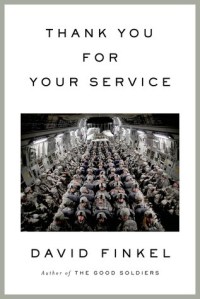 in 2013 and I was blown away. Thank You for Your Service is about what happens to a group of soldiers who spent fifteen months in Baghdad when they return to the United States. Finkel has amazing access and the subjects of his book trust him and he writes about them with great sensitivity. This book is a sequel, of sorts, to The Good Soldiers, which Finkel wrote about the same battalion when they were on duty in Iraq. (I haven’t read The Good Soldiers.) If you only read one book on this list, this should be the one.
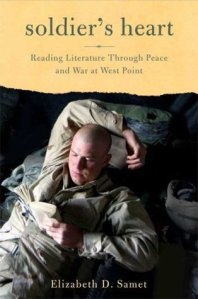 This is a memoir by a former professor of English at West Point. It’s an interesting account of a Harvard-educated politically liberal woman dealing with military hierarchy and learning about the ways her more conservative, bound-for-war students think about themselves and the classics of literature. I like it because I think it challenges stereotypes on both sides; I can’t think of anyone, no matter where they stand on the political spectrum, who could read this and not see the military a little differently.
 A book of short stories about soldiers on the frontlines in Iraq and Afghanistan, by a former soldier who served in Iraq. I still wish Klay had written a memoir instead of a book of short stories, but this book still provides a window into the lives of those who are actually fighting the wars.
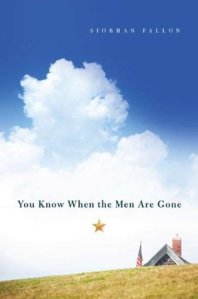 This book is the reverse of the previous one: a collection of short stories about the families who are left behind when soldiers go to war. Fallon, no surprise, is a military wife, and she writes about the stresses and terrors of having your husband on the frontlines in another country very movingly.
 For most Americans today losing a child or a spouse in Iraq or Afghanistan is an abstract concept; we murmur our sympathy but it’s not really a part of the everyday world we inhabit. It was very different for Americans who lived during the Civil War, and in this book Faust writes about how civilians and former soldiers reconciled themselves to the horrible human cost of the war, and how they grappled with the deaths once the war was over. It’s instructive to think about a world in which war deaths are much, much more common than they are today, and perhaps makes it a little easier to imagine what it would feel like if it were your child or spouse who wasn’t coming home.
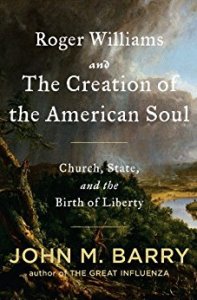 of Christianity — and Williams, an equally devout Christian who nonetheless believed that church and state should be completely separated. It was Williams’s ideas, Barry argues, that influenced the Founders’ thinking on religious freedom:
 st book I thought of when I saw Trump fulminating about broadcast licenses. Don’t you think Nixon would have liked to shut down the Washington Post in 1973? Do you think that his diehard supporters would have licensed Woodward and Bernstein? There are really good reasons why the government does not get involved in who is allowed to say what. (It’s worth noting, as well, that the Watergate story would be a mere footnote, if even that, if Woodward and Bernstein had not had the cooperation of anonymous sources.)
 through. But Applebaum really nails down the details of what it’s like to live in a society with no freedom, and the central philosophy of the oppressors that the government cannot be doing anything terrible because the government is always right is frighteningly close to what is being espoused by some Trump supporters today. This philosophy is exactly why the First Amendment was ratified in the first place.
 magisterial work of history (with two sequels, which you should also read) about the Civil Rights movement in general and Martin Luther King, Jr., in particular. To read this is to understand not just why the Civil Rights protests in the 1960s needed to happen, but also the absolutely central role the First Amendment played in the protests.
 entertaining, unputdownable examination of a fictional totalitarian society, and a tribute to freedom of expression.
 Sophronisba