 The Children’s Crusade, Ann Packer — I’ve had a soft spot for Ann Packer ever since The Dive from Clausen’s Pier pulled me out of a horrendous reading slump a few years ago. The Children’s Crusade is a solid read, consistently interesting with compelling characters. (Maybe the mother could have been a shade less self-centered and the father a shade less selfless, but I’m quibbling.) It wasn’t really a standout read for me–I’m not sure how well I’ll remember it in six months–but I enjoyed it nonetheless.
Girl at War, Sara Nović (quote) — Set in what was Yugoslavia, just as the civil war breaks out. I was pleasantly surprised by this one — I had expected it to be a sort of issue-of-the-week  novel, but it was much more than that. The writing is elegant, and I found that the protagonist really came to life. Nović resisted the urge to soften some of her main character’s sharp edges, which only made the novel feel more real. Some absolutely devastating scenes, and some beautiful ones.
My Name Is Lucy Barton, Elizabeth Strout — Beautiful! The best 2016 book I’ve read so far. It’s a very short novel — only about 200 pages, and many of those pages have only a few lines on them. But every word is well-chosen. I know that a lot of  readers disliked the brief chapters and the lightly-sketched incidents, but to me the vignettes gave the novel the effect of a verbal mosaic, and at the end I thought the portrait drawn of Lucy Barton was nearly perfect. It is similar to the way that Strout built the character of Olive Kitteridge in her eponymous novel, except that Olive Kitteridge is made up of short stories rather than paragraphs. (I can see similarities to Rachel Cusk’s Outline as well, which I also love.) Highly, highly recommended if this is your sort of thing.
Greek Fire, Poison Arrows, and Scorpion Bombs: Biological and  Chemical Warfare in the Ancient World, Adrienne Mayor — I always find Mayor’s thoughts interesting, but she does have a tendency to overinterpret. For example, because Hercules used fire in his mythical battle with the Hydra, “projectile weapons tipped with toxic or combustible substances must have been known very early in Greek history.” Well, maybe. Or maybe the mythmaker had a vivid imagination? Mayor’s interpretation is plausible, but “must” seems a bit strong to me.
No Fond Return of Love, Barbara Pym — British comfort food. I only wish I’d thought to make myself a pot of tea before I  read it. It’s my first Barbara Pym, and I will definitely check out more of her work. I do think that the comparisons to Jane Austen on the back cover of my edition were a bit overblown. What it reminded me of more than anything was early P. D. James, except without the murders. (That is a high compliment. I think P. D. James is hugely underrated as a writer.)
The Royal Experiment: The Private Life of George III, Janice Hadlow — More Brits, these of the royal variety. This is a biography of George III, with special attention to his family life. In other words, it is exactly the kind of thing that I eat up 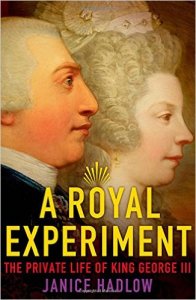 with a spoon. George III was a better father than most of his ancestors, which was a low bar to clear. Interestingly, rather than being a negligent, distracted parent, which one might expect–after all, he was the King of England–he was in many ways the original helicopter parent, so devoted to his daughters that he couldn’t bear for them to marry for decades after they came of age. I found it a fascinating book, if a bit long.
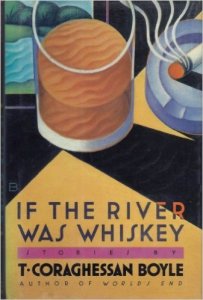 If the River Was Whiskey, T. C. Boyle — I like short stories and I like T. C. Boyle (although I miss the days when he went by T. Coraghessan Boyle, if only because “Coraghessan” is fun to say). But this collection didn’t quite do it for me. I think in his shorter work Boyle has a tendency to be weird and/or clever just for the sake of being weird and/or clever. I rarely feel a connection to his stories the way I did, for example, to San Miguel. He’s always worth reading, but nothing here excited me.
 The country was at war, but for most people the war was more an idea than an experience, and I felt something between anger and shame that Americans–that I–could sometimes ignore its impact for days at a time. In Croatia, life in wartime had meant a loss of control, war holding sway over every thought and movement, even while you slept. It did not allow for forgetting. But America’s war did not constrain me; it did not cut my water or shrink my food supply. There was no threat of takeover with tanks or foot soldiers or cluster bombs, not here. What war meant in America was so incongruous with what had happened in Croatia–what must have been happening in Afghanistan–that it almost seemed a misuse of the word.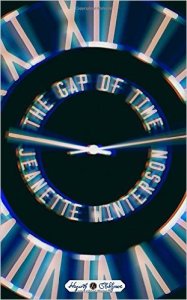
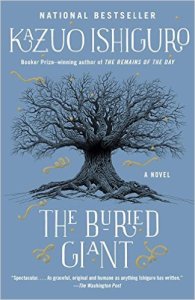 entitled to an off day, right? Still, I was nervous enough that I put off reading The Buried Giant for a year. A year. That is a lot for someone with no impulse control. And I am sad to report that my fears were justified: The Buried Giant just didn’t work for me. I found it slow and overwritten. How could the man who gave us
  bit. But I really did enjoy the time I spent in Mazie’s company: she was a charming companion even when she faced heartbreak. Pete Sorenson (the character who, in the novel, finds her diary) says, “I just wanted it to go on and on. I wanted her to live forever.” Me too, Pete.
 And to be fair, the chapters on naming and swearing did hold my attention. (I’ll be scheduling a therapy session to figure out why, exactly, those were the only two topics that caught my interest.)
 loved the way that he wrote. I still do, although I really wrestle with his sexism. I think he writes women terribly, and I don’t think Brett Ashley holds up particularly well. I still think his best book is
  And the world goes on regardless of joy or despair or one woman’s fortune or one man’s loss. And we can’t know the lives of others. And we can’t know our own lives beyond the details we manage. And the things that change us forever happen without us knowing they would happen. And the moment that looks like the rest is the one where hearts are broken or healed. And time that runs so steady and sure runs wild outside of the clocks. It takes so little time to change a lifetime and it takes a lifetime to understand the change.
 I respond very well to such paragraphs, and indeed I loved this book all the way through. I could quibble with some plot developments — I wasn’t that interested in the plot, and I’m not sure Brian Moore was either — but I thought that the character development of Judith Hearne was nothing short of brilliant. Take that paragraph, for example — it’s in the first chapter, and already you know so much about Judith Hearne: her self-consciousness about being single, her ready acceptance of the idea that she was uninteresting on her own, her desire to ingratiate, her insistence that her “solitary life” included “great rewards”. Yes, Judith can be off-putting with her insistence on conventional mores–she’s scandalized by a joke about Mary Magdalene–but she’s heart-breaking, too.
 As the book went on I began to sympathize more with the piety that I had originally found grating. Catholicism is her mainstay; the Sacred Heart oleograph she displays in her room is the only proof that her life matters at all. The very worst thing to befall Judith Hearne may be near the end of the book, when she begins to lose her faith:
 Here is something that is happening in 2016: Julia Ioffe, a Jewish journalist, wrote a profile of Melania Trump for GQ, and she incorporated less-than-flattering facts about Melania Trump’s father, and now she has a bunch of Trump supporters tweeting her with references to the Holocaust.
 violence? I would never call Trump a totalitarian, if only because I find it difficult to imagine him implementing the kind of centralized economic control that was the hallmark of totalitarian governments. But I think some of his rhetoric and behavior taps into a totalitarian impulse in his supporters–a desire for strong authority, a desire to show people who’s boss. They’re
  Sophronisba